

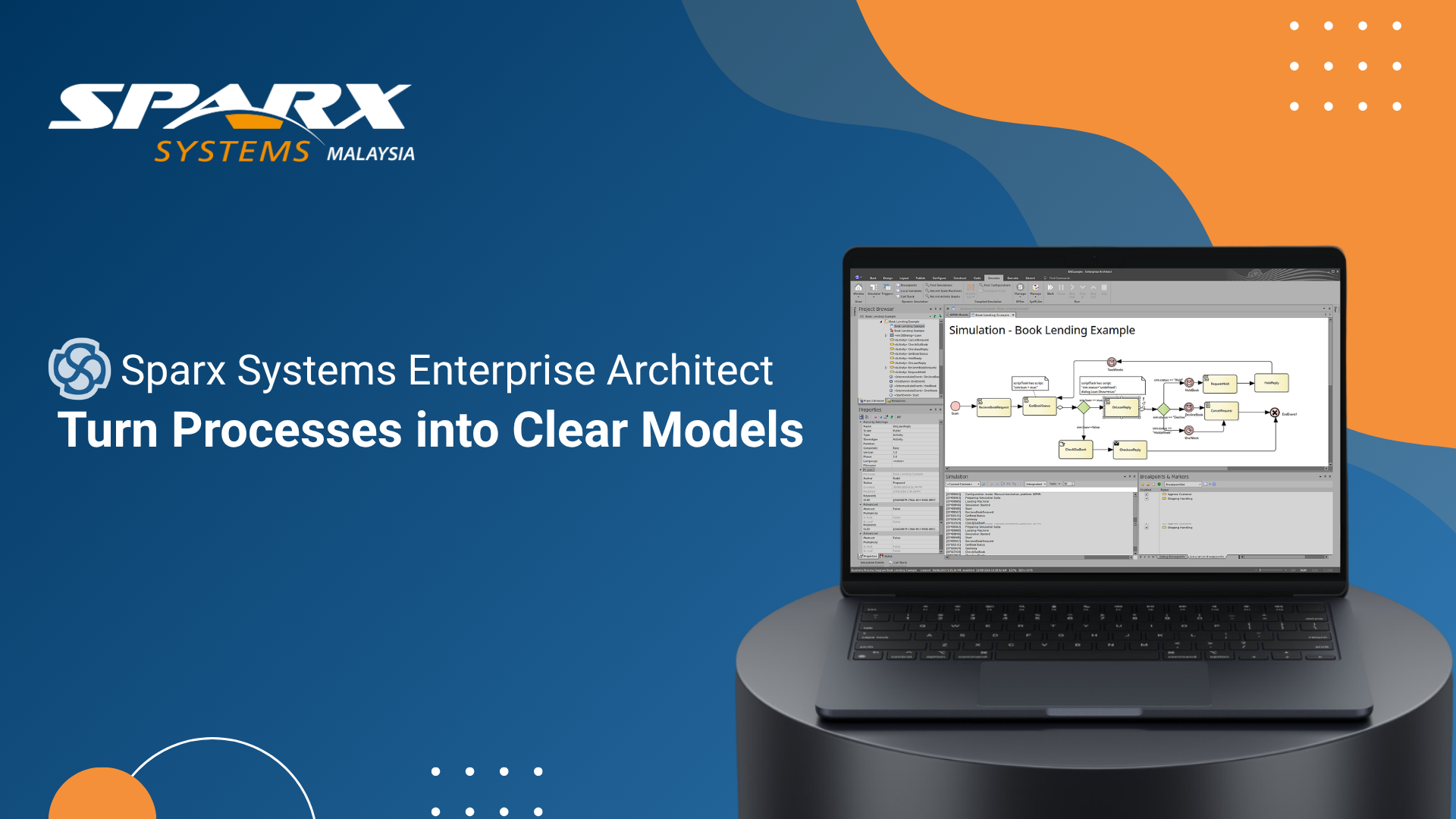
BPMN Modeling with Sparx Systems Enterprise Architect
Business process modeling is at the heart of most enterprise architecture and transformation initiatives. Whether the goal is documenting current processes for analysis, designing future-state workflows, or generating executable process definitions, the quality of the modeling tool directly affects the quality of the outcome. Sparx Systems Enterprise Architect supports BPMN 2.0 natively, providing a complete business process modeling environment that integrates seamlessly with the broader architecture modeling capabilities that EA is known for.
Explore the Full Sparx EA Capabilities Behind BPMN Modeling
Understand how Sparx Enterprise Architect supports BPMN 2.0, process traceability, and integration with enterprise architecture and system design.
Native BPMN 2.0 Support
Sparx Enterprise Architect implements Business Process Model and Notation version 2.0 — the current standard published by the Object Management Group. BPMN 2.0 introduced a richer set of process constructs compared to earlier versions, including event subprocess support, enhanced gateway semantics, conversation and choreography diagrams, and improved data object handling. All of these constructs are available in Sparx EA's BPMN toolbox, which means teams can model both simple linear processes and complex, exception-handling workflows without resorting to workarounds.
The EA toolbox for BPMN presents the full palette of flow objects — start, intermediate, and end events in their many variants; task types including service tasks, user tasks, business rule tasks, and script tasks; gateways including exclusive, inclusive, parallel, and event-based; and sub-processes, call activities, and pools and lanes for representing organizational boundaries. Sequence flows, message flows, associations, and data associations complete the notation set. Teams working to BPMN 2.0 standards will find Sparx EA's implementation comprehensive and conformant.
Connecting Process Models to Architecture
The most significant advantage of using Sparx Enterprise Architect for BPMN modeling, compared to standalone process modeling tools, is the integration with the broader architecture model. In EA, a BPMN process diagram exists in the same repository as the ArchiMate enterprise architecture models, UML system designs, and requirements that collectively describe the organization and its systems. This means that process models can be directly linked to the architectural components that support them.
A business task in a BPMN process can be linked to the application component in an ArchiMate diagram that automates it, which in turn links to the technology infrastructure that hosts that application. When a process changes, the traceability network makes the downstream architectural implications immediately visible. This level of cross-model integration is only possible when all the modeling happens in the same repository — which is a core architectural decision behind Sparx EA's design.
Start Modeling Your Business Processes
Experience how Sparx EA supports real-world BPMN modeling, from process capture to documentation and automation.
BPEL Script Generation for Executable Processes
For organizations implementing process automation, Sparx Enterprise Architect supports the generation of Business Process Execution Language (BPEL) scripts from BPMN process models. BPEL is the standard language for defining executable business processes in web service environments, and the ability to generate BPEL from a BPMN model bridges the gap between the analyst's process design and the developer's implementation work.
This capability is particularly valuable in integration-heavy environments where business processes orchestrate calls to multiple enterprise services. The business analyst can design the process using BPMN notation in Sparx EA, and the generated BPEL output provides the implementation team with a starting point that accurately reflects the intended process logic. This reduces the translation overhead that typically occurs when process designs are handed off from business analysis to technical implementation.
Process Documentation and Reporting
Business process documentation is a requirement in virtually every industry — whether for regulatory compliance, quality management systems, operational handbooks, or change management programs. Sparx Enterprise Architect's documentation generation engine produces comprehensive process documentation directly from BPMN models, including diagram exports, element property tables, and narrative descriptions. Because documentation is generated from the live model, it reflects the current state of the process design rather than a snapshot that may have aged.
Rich text descriptions can be attached to individual BPMN elements within the model — process steps, decision points, and sub-processes can all carry narrative context that appears in generated documentation. This allows business analysts to maintain a single source of truth for both the visual process model and the textual descriptions that accompany it, eliminating the document maintenance overhead that plagues teams using separate tools for diagrams and documentation.
Enable Collaborative Process Modeling in the Cloud
Access Sparx EA through a secure, cloud-based environment that supports distributed teams working on shared process models.
Multi-User Process Modeling for Large Teams
Business process modeling programs frequently involve multiple analysts working on different process areas simultaneously. Sparx EA's shared repository architecture supports this concurrent working model — multiple analysts can work on different process packages within the same project, with element-level locking preventing conflicting edits. Role-based access controls ensure that analysts can only modify the processes within their scope, while architects and program managers retain oversight of the complete process landscape.
For organizations that need to share process models with broader audiences — process owners, business unit managers, or external auditors — Sparx Systems Prolaborate extends the reach of EA's BPMN models to a browser-based audience without requiring EA licenses. This makes it practical to involve the people who own and execute business processes in the review and validation of the models that represent them, closing the loop between the modeling team and the business.