

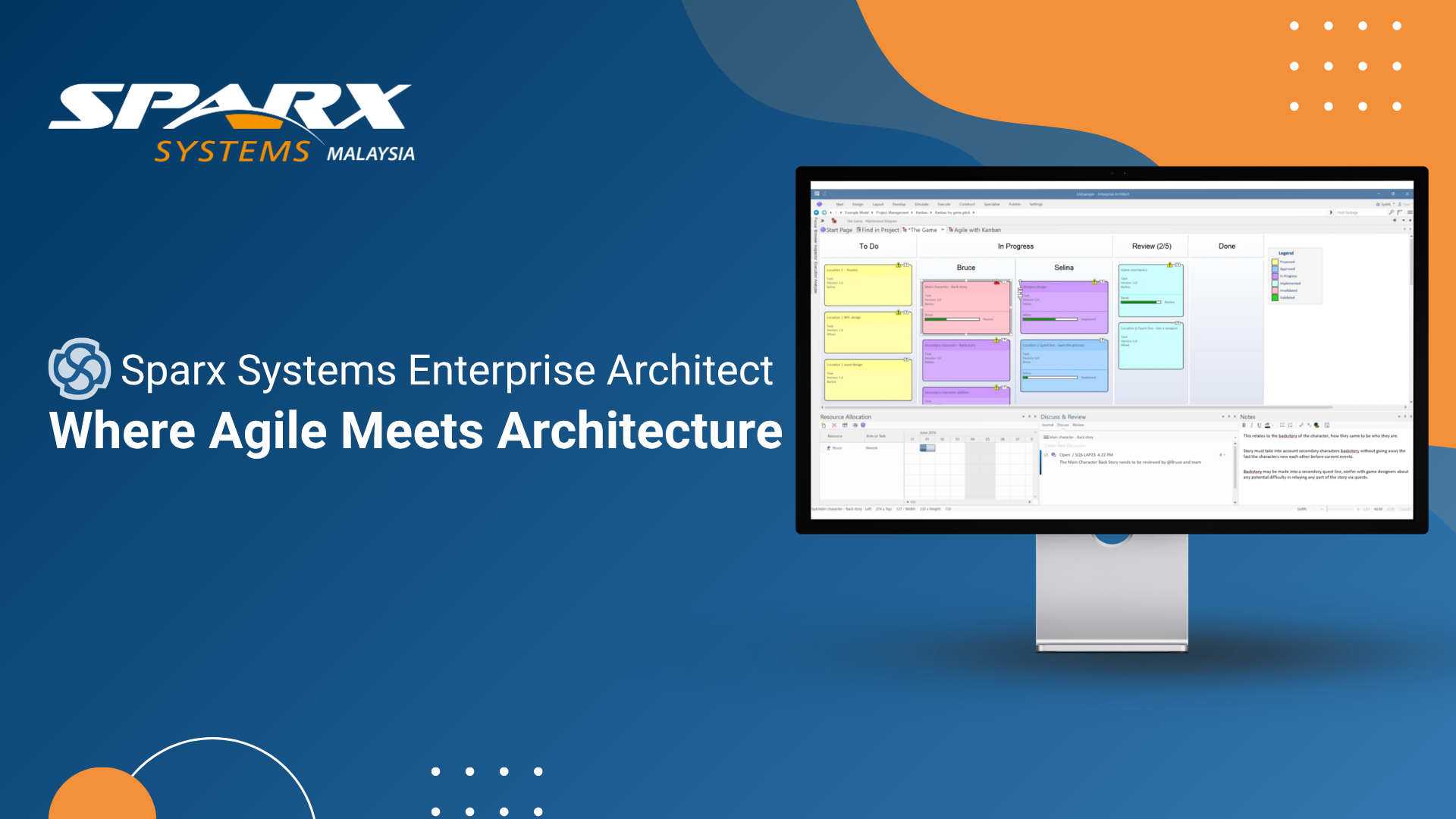
How Sparx EA Strengthens Agile Development Practices
A common misconception is that modeling tools and agile development are in tension — that the documentation-heavy approach of traditional architecture conflicts with the iterative, adaptive nature of agile. In practice, the opposite is true when the right tool is in place.
Sparx Enterprise Architect supports agile development practices by providing a living architecture that evolves alongside the product, traceability that links every sprint to business outcomes, and collaboration capabilities that keep the whole team working from a shared understanding of the system.
Try Sparx Enterprise Architect in Your Agile Workflow
Explore how Enterprise Architect fits into your sprint cycles, from modeling user stories to maintaining traceability across iterations.
Keeping the Architecture Aligned with Iterative Development
In agile environments, architecture needs to be adaptive rather than fixed. Sparx EA supports this through a model structure that is easy to update incrementally as design decisions emerge. Rather than producing a monolithic architecture document upfront, teams can start with a high-level model and progressively add detail sprint by sprint as the design is elaborated. The repository's version control and baseline capabilities allow teams to snapshot the architecture at the end of each sprint, creating a record of how the design evolved over time.
UML diagrams in Sparx Enterprise Architect can be maintained at whatever level of fidelity serves the team. A sequence diagram that captures the flow of a user story helps developers understand the expected system behaviour before they write code. A component diagram that shows how new microservices integrate with existing systems helps the team avoid integration surprises mid-sprint. Because these diagrams live in the shared repository rather than in slide decks, they are accessible to the whole team and easy to update when the design changes.
Requirements Traceability Across Sprints
Agile teams work from backlogs, but the items in those backlogs ultimately exist to address business needs. Sparx EA's requirements management capabilities allow teams to capture those business needs formally and trace them through to the design elements and code artifacts that implement them. This traceability is valuable in two directions: it helps teams demonstrate that every feature delivers against a stated business requirement, and it helps product owners understand the design implications of changing or reprioritizing backlog items.
End-to-end traceability from requirements through analysis, design models, implementation, and deployment means that as development progresses across sprints, the architecture model becomes a living record of decisions made and requirements addressed. Impact analysis capabilities allow teams to quickly assess the ripple effects of a change request before committing to implementation — reducing the cost of late-stage changes that agile teams inevitably face.
Explore the Features That Support Agile Delivery
Discover how Enterprise Architect enables iterative modeling, traceability, and integration with agile delivery tools.
Supporting Agile Architecture Reviews
Agile teams typically hold architecture reviews at key milestones — before starting a new feature area, when a significant design decision needs to be made, or during sprint retrospectives when the team reflects on technical debt. Sparx Enterprise Architect supports these reviews by providing a shared, visual representation of the system architecture that all team members can engage with.
The documentation generation capabilities of Sparx EA mean that review materials can be produced directly from the live model rather than assembled manually. This ensures that review participants are working from the current state of the architecture rather than a document that may have been last updated weeks ago. Role-based access controls allow architecture decisions and review outcomes to be recorded within the model itself, creating a traceable decision log embedded in the architecture.
Integration with Agile Delivery Tools
Modern agile teams use tools like Jira and Azure DevOps to manage their backlogs, sprints, and delivery pipelines. Sparx Systems Enterprise Architect connects with these platforms, allowing teams to link architecture artifacts to delivery work items. This integration bridges the gap between the architecture model and the backlog — design decisions captured in EA can be associated with the Jira epics or Azure DevOps features that implement them, creating a coherent picture from business requirement through architecture to delivery task.
For organizations using Sparx Systems Prolaborate alongside Enterprise Architect, agile teams gain an additional collaboration layer — a browser-based portal where stakeholders can review published architecture diagrams, add in-context comments, and participate in structured approval workflows without needing an EA license. This is particularly useful in scaled agile environments where product owners, business analysts, and other non-technical contributors need to engage with architecture content without becoming EA users.
Support Agile Teams with a Connected Architecture Platform
Enable distributed agile teams with secure access, shared repositories, and real-time collaboration through the Sparx Cloud Platform.
Code Generation to Accelerate Sprint Delivery
Sparx EA's code engineering capabilities provide a direct bridge between design and implementation that agile teams can leverage to accelerate delivery. Bidirectional code generation means that skeleton class structures, interfaces, and method signatures can be generated from UML class diagrams — giving developers a head start on implementation and ensuring that the code structure matches the agreed design. Reverse engineering capabilities allow teams to import existing codebases into EA and generate diagrams from them, which is particularly useful when a new team member needs to understand an unfamiliar part of the system.
The combination of requirements traceability, iterative modeling support, delivery tool integration, and code engineering makes Sparx Enterprise Architect a genuinely useful asset in an agile development environment. Far from being a documentation overhead, a well-maintained EA model becomes one of the team's most valuable assets for shared understanding and informed decision-making.